
 PL
 EN
You can't hear your own part in a full-choir recording
The soprano tune covers the alto, and the tenor gets lost between soprano and bass. Singers of the inner parts mostly hear other people's lines.
A guide for choir singers
A rehearsal lasts two hours and a new piece runs to several pages. To sing with confidence instead of searching for your line, you need to arrive with the part already in your ear. Here are ways that help singers practise on their own — with the score, a recording and no one at the piano.
Most singers have a recording of the piece and the score. Even so, practice at home often ends after a few minutes — usually for one of these reasons:
The soprano tune covers the alto, and the tenor gets lost between soprano and bass. Singers of the inner parts mostly hear other people's lines.
With several pages, repeats and long notes, the eye can't keep up with the ear. Once lost, you start again from the top — and practise only the first page once more.
A difficult passage lasts a few seconds, and getting back to it means scrubbing through the whole piece. Concert tempo is rarely right for a first read.
Singing along with a recording of your own part feels as if everything fits. The real test is singing against the rest of the choir — with no one carrying your line.
A few principles used by conductors and experienced singers. No special equipment needed — the score, a recording and a phone are enough.
Don't sing the first time — just listen and follow your part in the score. Mark the places where you get lost: entries after rests, leaps, key changes.
If you have a recording of your part alone, start there. Once the line is familiar, move to the full-choir recording and listen to how your part fits with the others.
Pick one musical phrase and repeat it until you can sing it without stopping. Practise the hard places more often than the easy ones — that is where rehearsal time is lost.
Before singing, speak the words in the rhythm of the notes. Especially in Latin or a foreign language this saves half the work — a melody settles far more easily on familiar words.
The best test before rehearsal: you hear the other parts and sing your own alone. It shows at once where you lean on the recording and where you really know the line.
A quarter of an hour a day for several days does more than an hour the evening before rehearsal. Finally, record yourself on your phone — your own recording shows what doesn't sound right yet.
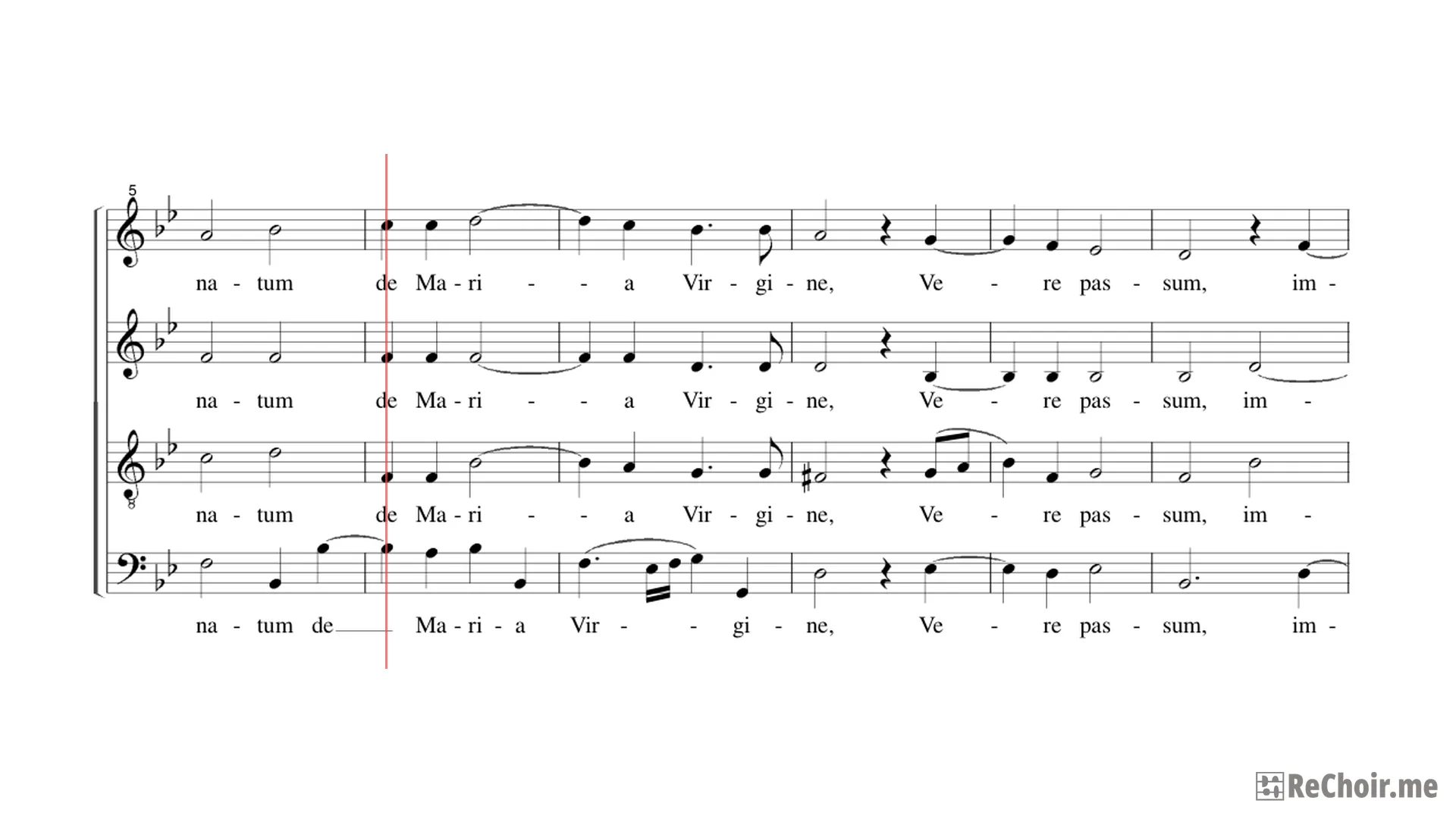
Most time goes on finding your place in the score. That is why ReChoir links the recording and the score: a cursor shows which bar is sounding, and the music moves on to the next system and the next page by itself.
Switch the recording at any moment — the score and cursor carry on, only the sound changes.
In ReChoir
ReChoir is an app for running a choir. The ensemble's repertoire, scores and recordings live in one place, and every singer has them in their digital folder — on phone, tablet and computer.
The cursor in the score moves with the music and pages turn by themselves. Click the music and the recording jumps to that place.
A piece can come with recordings of the individual parts, the full choir and versions without a chosen part — for singing with the rest of the ensemble. You can add your own recordings or generate them in ReChoir: the singing synthesizer sings every part with its text.
Scores and recordings are available on your phone, even without an internet connection — on the bus, on the train, before rehearsal.
Scores and recordings are attached to the piece in the ensemble's repertoire — no mailing files around or hunting for “the latest version” in messengers.
The features on this page work for ensembles already using ReChoir. If you'd like your choir to practise this way, write to us — we'll show you the app on your own repertoire.
First listen to the piece with the score in front of you, then learn your part on its own and in sections — starting with the hard places. Several short sessions on different days do more than one long one. Finally, sing with a recording that leaves your part out: it shows whether the part is secure.
Usually the conductor or a section leader prepares it: a rehearsal recording, the part played on the piano or a file from notation software. In ReChoir recordings of individual parts can be attached to the piece, so every singer has their part in the app. If there are no recordings, ReChoir can generate them from the score: the singing synthesizer sings every part with its text.
Not always — many singers learn by ear. But the score helps a lot: it shows where the line goes up, where the rests are and how long to hold a note. Following the score along with a recording is a good way to learn to read it along the way.
Usually 15–20 minutes a day for a few days before rehearsal is enough. Regularity matters more than length — and practising the hard passages rather than just singing the piece from the top.
A recording of the piece with one part removed — for example all voices except the alto. The alto then sings her line alone while hearing the rest of the choir, as at rehearsal. It is the best test of whether you have mastered the part.
Yes. Pieces a singer has opened before can be viewed and played even without an internet connection.
Leave your contact details — we will get back to you and show ReChoir.me on the example of your ensemble.
